Read The Fox in Love With The Moon Online
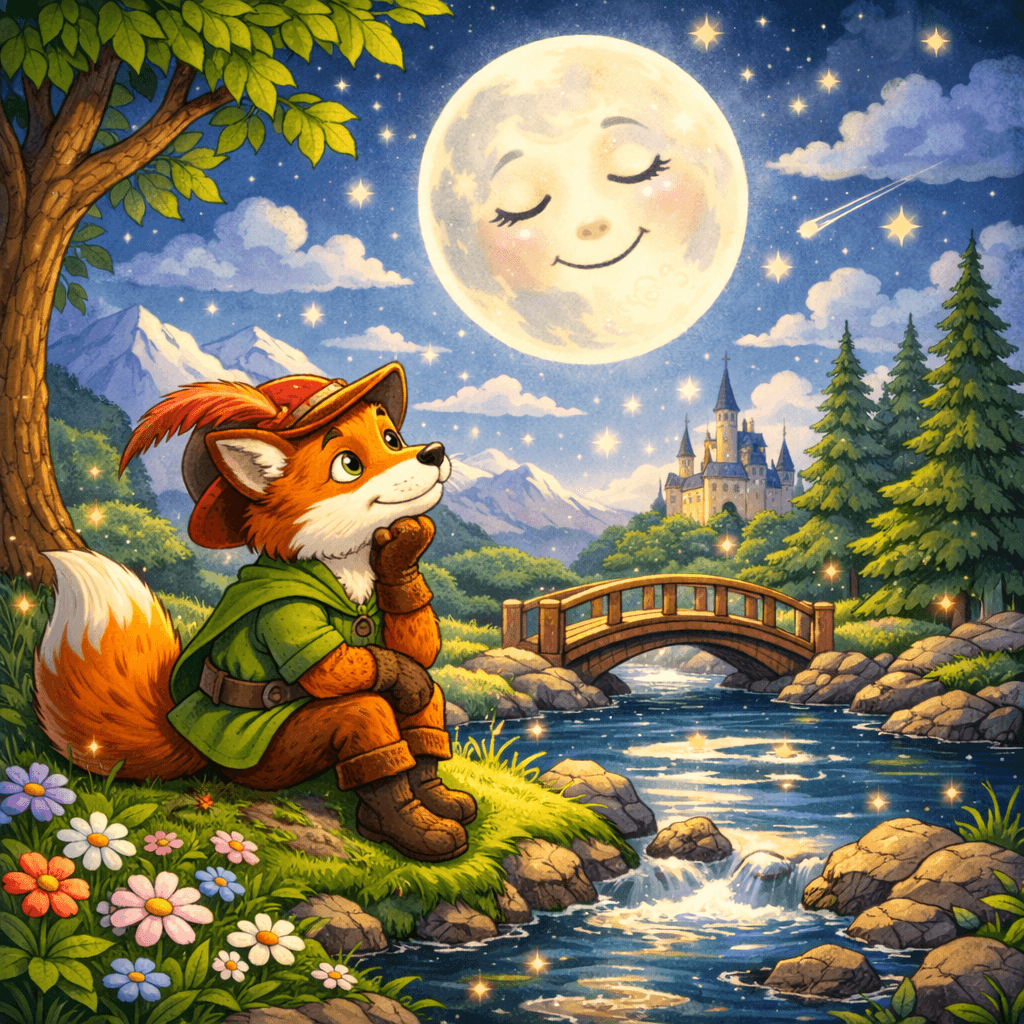
Once upon a time, there was a fox with reddish fur who lived near a quiet forest, among gentle hills and flowers that opened at dusk. He was light on his feet, curious, and very observant. During the day, he ran among the trees, crossed little streams, and hid in the tall grass. But when night came, he always did the same thing: he climbed onto a rock where he could look up at the sky.
There, still and silent, he lifted his nose and gazed at the Moon.
It was big, round, and bright. Sometimes it looked like a silver lamp. Other times, it looked like a boat floating in the darkness. The fox stared at it so often that he began to feel something very special in his heart.
“How beautiful you are,” he whispered every night. “I wish I could be with you.”
Little by little, the fox began to think he was in love with the Moon. He spoke to it softly, told it about his day, and shared the things he saw in the forest.
“Today I found a field full of daisies,” he would say.
“Today I heard the crickets singing by the river.”
“Today I thought of you from the moment the sun came up.”
The Moon, high above, kept shining in silence.
One night, the fox decided he no longer wanted to admire it only from far away.
“I will go and find it,” he said firmly. “It cannot be so far if I see it every night.”
So he began his journey. He ran along narrow paths, climbed hills, and crossed clearings bathed in silver light. The farther he went, the more he thought he was getting close. But the Moon remained high above, calm and distant.
As he passed by a pond, he saw its reflection in the water.
“There you are!” he cried happily.
He stepped closer, his heart beating very fast. The Moon trembled on the surface of the pond, round and bright, as if it were waiting for him.
“Now I can reach you,” said the fox.
He stretched out a paw and touched the water.
Splash.
The reflection broke into many little pieces of light.
The fox jumped back.
“Oh no,” he said sadly. “I have lost you again.”
At that moment, a turtle resting near the shore lifted its head.
“You have not lost it,” said the turtle in a calm voice. “You only touched its reflection.”
The fox lowered his ears.
“But I want to reach it,” he replied. “I look at it every night, and my heart runs after its light.”
The turtle looked at him quietly.
“There are beautiful things that cannot be caught,” it explained. “Sometimes it is enough to look at them, love them, and be thankful that they are there.”
But the fox was not convinced.
“I will keep trying,” he said.
He continued on until he reached a very high hill. From there, the Moon looked even bigger.
“If I climb a little higher, maybe I can touch it,” he thought.
So he began to climb over stones and branches. He climbed carefully, slipped twice, and got up again. At last, when he reached the top, he stretched his paws toward the sky.
But the Moon was still far away.
The fox took a deep breath.
“Why are you so distant?” he asked sadly.
The soft night wind moved the leaves, and an owl perched on a nearby branch heard him.
“Because the Moon does not come down to the earth,” said the owl. “It watches over the sky, the night, and dreams.”
The fox looked at the owl with disappointment.
“Then I will never be close to it.”
The owl tilted its head.
“Maybe not in the way you imagine,” it answered. “But that does not mean it is truly far away.”
The fox did not understand those words, though he kept thinking about them as he climbed down the hill.
That night, he wandered without direction, more slowly than before. He no longer ran with excitement. Now he walked with a tired heart. He passed by the river, crossed the field, and returned to his usual rock.
He sat down in silence.
The Moon was in the sky, bright and peaceful, just as it was every night.
“I have run so far for you,” murmured the fox. “I went to the pond, climbed the hill, and followed your light through the whole forest. But I could not reach you.”
For the first time, instead of speaking right away, he stayed still. Then he began to notice things he had not seen so carefully before. The Moon’s light fell over the sleeping flowers. It silvered the leaves of the trees and made the river shine like a ribbon of crystal. Even his rock looked different beneath that gentle glow.
The fox looked at his paws, his tail, and the ground around him.
Everything was touched by the Moon’s light.
Then he opened his eyes wide.
“You have been here all this time,” he said softly.
He could not hug the Moon or carry it with him, but its light reached the forest, the river, the hill, and even his own little rock. It was not as far away as he had thought. In some way, it had always been with him.
At that moment, the fox felt his sadness grow smaller.
“Perhaps love does not always mean having someone close,” he whispered. “Perhaps it also means admiring, caring, and being thankful.”
A firefly drifted past him, glowing in the dark.
“That sounds very wise,” said a tiny voice.
The fox smiled when he saw it.
“I think I am only now beginning to understand,” he replied.
From that night on, the fox still climbed onto his rock to look at the Moon. But he no longer ran desperately after it or tried to catch it in the water. Now he sat quietly, watched its glow, and enjoyed the peace it brought to the forest.
Sometimes he still spoke to it, just as before.
“Good night, Moon.”
“Thank you for lighting the paths.”
“Thank you for keeping me company at night.”
And although the Moon remained silent, the fox no longer felt sad. He had understood that some things are not meant to be possessed, but to be loved from afar.
As time passed, the whole forest seemed more beautiful to him. He noticed the distant song of the crickets, the dance of the fireflies, the murmur of the river, and the fresh scent of the night flowers. He discovered that the light he admired so much in the Moon had also taught him to see more clearly everything around him.
And so, the fox in love with the Moon stopped chasing the impossible and learned something very precious: that some loves are not held with paws, but kept gently in the heart.
The end