Read The Flower of The Cantuta Online
Once upon a time, high in the mountains of Peru, there were two neighboring kingdoms separated by hills, rivers, and old sorrow. For many years, the people of those lands had lived in anger. One kingdom looked to the sunrise, and the other looked to the sunset. Their shepherds crossed different valleys, their songs were not sung together, and even their children grew up hearing stories of mistrust.
Yet the mountains were the same for both.
The same wind passed over their fields. The same clouds brought rain to their crops. The same stars watched over their nights.
In one kingdom lived a young prince who was brave and thoughtful. In the other lived a princess who was kind and gentle. They had never met when they were children, for the old quarrel between their peoples kept them apart.
But one spring morning, when the snow had melted from the hills and the streams ran clear and bright, the prince rode alone through the mountain paths. At the same time, the princess had gone out with her companions to gather flowers near a quiet valley.
There, among the green slopes and the singing birds, they saw each other for the first time.
The prince stopped his horse.
The princess lifted her eyes.
For a moment, neither of them spoke.
Then the prince bowed his head.
—Good morning, he said.
—Good morning, replied the princess.
They spoke only a little that day, for both knew the old rule that those from one kingdom should not trust the other. Still, when they returned to their homes, neither of them forgot the meeting in the valley.
After that, they found reasons to return to the same place. Some days they spoke of the mountains. Some days they spoke of their families, their people, and the sadness that had stood between their lands for so long.
The prince had a calm voice, and the princess listened with care. The princess had a hopeful heart, and the prince felt peace whenever she spoke.
At last the day came when they understood what was already growing in silence between them.
—If our peoples were not enemies, said the prince, —I would ask to walk beside you always.
The princess looked at the valley, bright with morning light.
—If our peoples were not enemies, she answered, —I would say yes.
From that day on, their hearts were full of both joy and sorrow. They had found love, but they knew the old hatred between the kingdoms would not easily disappear.
Still, they hoped.
They believed that kindness might do what anger had failed to do. They believed that if their families saw that peace was possible, perhaps the two lands could finally live without fear.
So the prince went to his father, and the princess went to hers. Each spoke honestly and asked that the old quarrel should end.
But the kings were proud.
One looked at the past and would not forgive. The other listened only to his wounded pride.
—There will be no peace, said one king.
—There will be no union, said the other.
When the prince and princess heard these words, their hearts became heavy. Yet they did not stop hoping. They met once more in the valley, beneath the open sky, and promised that they would never wish harm upon either people.
—If we cannot join the kingdoms, said the prince, —let us at least keep goodness in our hearts.
—Yes, said the princess. —Hatred has already lasted too long.
But the kings, blinded by anger, prepared for war.
Soon the quiet valleys filled with the sound of marching feet. Spears shone in the sun. Shields were lifted. The people of both lands trembled as the armies moved toward one another.
The prince and princess climbed a hill from which they could see the two kingdoms below. They looked upon the fields, the rivers, and the homes of their people, and they wept to think that so much beauty would again be touched by sorrow.
Then they lifted their voices to the heavens.
—Great Spirit, prayed the prince, —do not let hatred rule forever.
—If peace cannot come through us, prayed the princess, —leave at least a sign that love is stronger than anger.
The sky grew strangely still.
The wind slowed.
The clouds above the mountains seemed to shine with a soft and quiet light.
Then a voice, gentle and powerful, seemed to pass through the valley like a whisper carried by the air.
—What is given in love is never lost.
At that moment, a bright drop, red as a faithful heart, fell to the earth. Beside it fell another, golden as hope in the morning sun. Where they touched the ground, something began to grow.
The prince and princess stepped back in wonder.
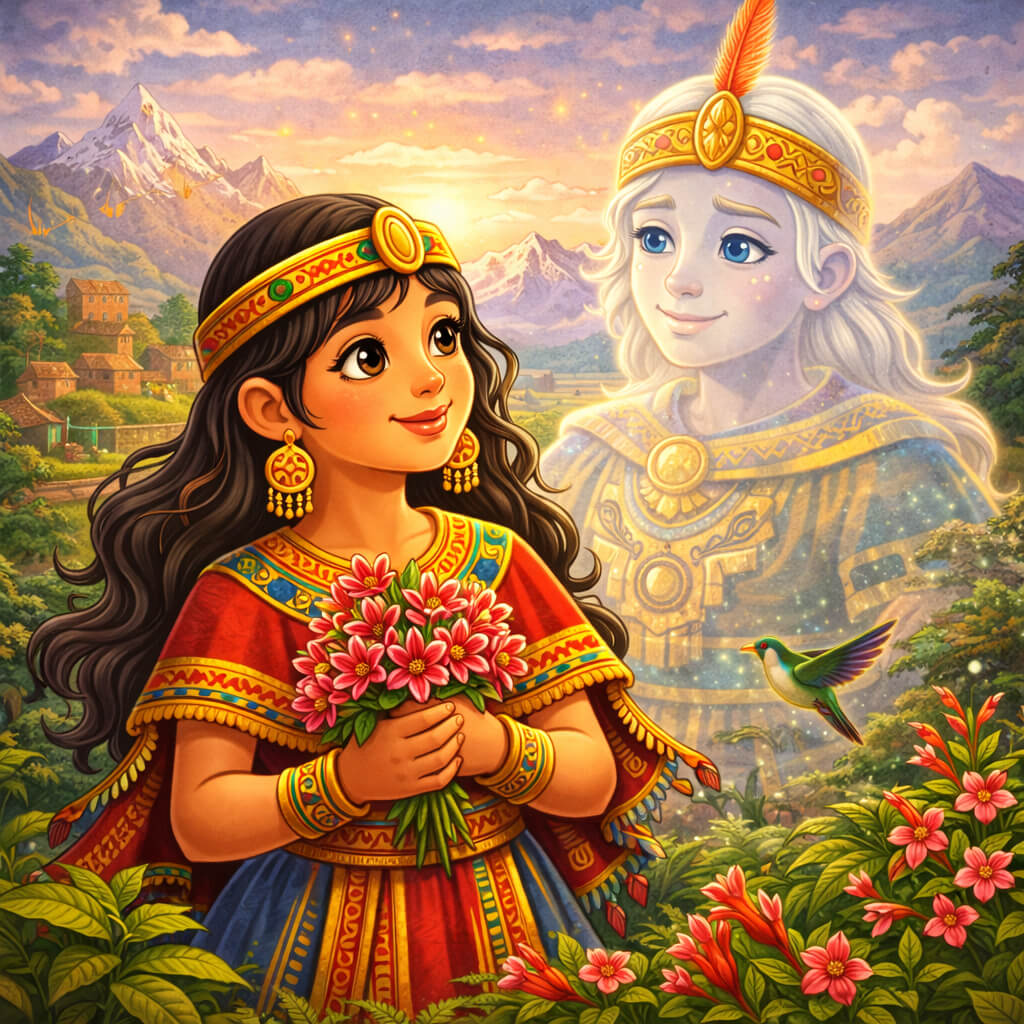
Before their eyes rose a tall and graceful flower, with red petals above and golden petals below. It swayed gently in the wind, as if it had been born from both sorrow and promise.
Soon more flowers bloomed across the hillside.
The people below looked up and saw them shining in the light.
They had never seen such a flower before.
The armies stopped.
The kings themselves came forward and stared in silence. The red of the flower reminded them of courage and sacrifice. The golden color reminded them of light, friendship, and the warmth of peace.
No one raised a weapon.
No one gave another order.
For a long time the valley was quiet.
At last, one of the old kings lowered his head.
—What have we done? he said softly.
The other king looked at the flowers trembling in the wind.
—We have let anger live where love wished to grow, he answered.
That day, no battle was fought.
The soldiers returned to their homes. The people of both kingdoms crossed the valley not with fear, but with cautious peace. In time the old quarrel began to fade, and the red-and-gold flower became a sign that the mountains remembered both love and forgiveness.
As for the prince and the princess, the old people say their story lived on in every cantuta that bloomed among the high Andean slopes. Some say the flower carried the color of their hearts. Others say it was a gift from heaven, so that no one would forget what peace had cost.
And from that day on, when the people saw the cantuta swaying in the mountain wind, they remembered something precious: hatred may divide for a time, but kindness leaves roots that can bloom for generations.
The end