Read The Origin of Lake Titicaca Online
Once upon a time, high in the Andes, there was no great lake between the mountains. In that place there was a wide and beautiful valley, full of green fields, clear streams, and gentle animals. The people who lived there had everything they needed. The earth gave them food, the sky gave them light, and the mountains watched over them in silence.
The people of that valley lived in peace.
Above them rose the mighty Apus, the sacred mountain spirits. The people honored them, and in return the Apus protected the valley from harm. The rains came at the right time, the grass grew fresh, and the herds were strong.
But there was one rule that everyone knew.
High above the valley, hidden among the peaks, burned a Sacred Fire.
No one was to climb to that place.
No one was to go near it.
The elders repeated the warning to the children, and the children, when they grew older, repeated it again. For many years, the people obeyed, and the valley remained happy.
Among those who lived there was a young shepherd boy named Amaru. He was kind and hardworking, and he loved the mountains very much. Every morning he took his llamas and sheep across the hills, and every evening he returned home with songs in his heart.
One afternoon, while the animals grazed, Amaru looked up toward the highest peaks. There, far above the valley, he thought he saw a strange glow.
It was not the glow of the sun.
It was brighter and deeper, like a living flame.
Amaru remembered the old warning.
Still, he could not stop thinking about it.
That evening, as the people sat together, he heard some of the younger men speaking in low voices.
—Perhaps the Sacred Fire hides a great treasure, said one.
—Perhaps the Apus only wished to keep it for themselves, said another.
Amaru felt uneasy.
—We should not speak that way, he said. —The valley has given us enough.
But curiosity had already entered their hearts.
Day after day, more people began to wonder about the forbidden place. At first they only spoke of it. Then they pointed toward the peaks. Then, little by little, they began to forget why the warning had been given.
At last, one cold morning, several people decided to climb the mountain.
Amaru tried to stop them.
—Please do not go, he said. —Some doors are closed for a reason.
But they did not listen.
Some laughed at his caution. Others told him he was afraid. And so they climbed higher and higher, until they reached the place where the Sacred Fire burned among the rocks.
At first they stood in wonder.
The fire shone with a fierce and terrible beauty. It did not move like an ordinary flame. It seemed alive. It rose and curled and flashed without wood, without smoke, and without end.
The people came closer.
Then the mountain gave a low and heavy sound.
The ground trembled beneath their feet.
Amaru, who had followed at a distance, cried out:
—Run! Run back!
But it was too late.
From the Sacred Fire came a great roar, and from the cracks in the mountain rushed wild creatures of flame and shadow, fierce as hunger and swift as storm winds. They leaped down the slopes and spread fear through the valley.
The people ran in every direction.
The animals cried out.
The earth shook again.
Amaru gathered the frightened children and led them away from the open fields, but all around him there was confusion. Smoke and dust filled the air. The once peaceful valley had become a place of fear.
Then the people lifted their voices to the Apus.
—Forgive us! they cried. —Forgive our pride and save us!
For a long moment, nothing happened.
The sky darkened.
The mountains stood silent.
Then, from the highest peaks, the snows began to melt.
At first it was only a little stream.
Then another.
Then many waters rushed downward together, bright and cold and powerful. They poured through the valley, over the fields, through the grasslands, and among the frightened people. The fierce creatures of flame were covered and swallowed. The Sacred Fire disappeared beneath the flood.
Higher and higher the waters rose.
The people climbed to safety on the hills and rocky slopes. They watched in silence as the streams joined and spread until the whole valley shone like a mirror beneath the sky.
Where fields had once grown, there was now water.
Where pathways had once crossed, there were now shining waves.
The valley was gone.
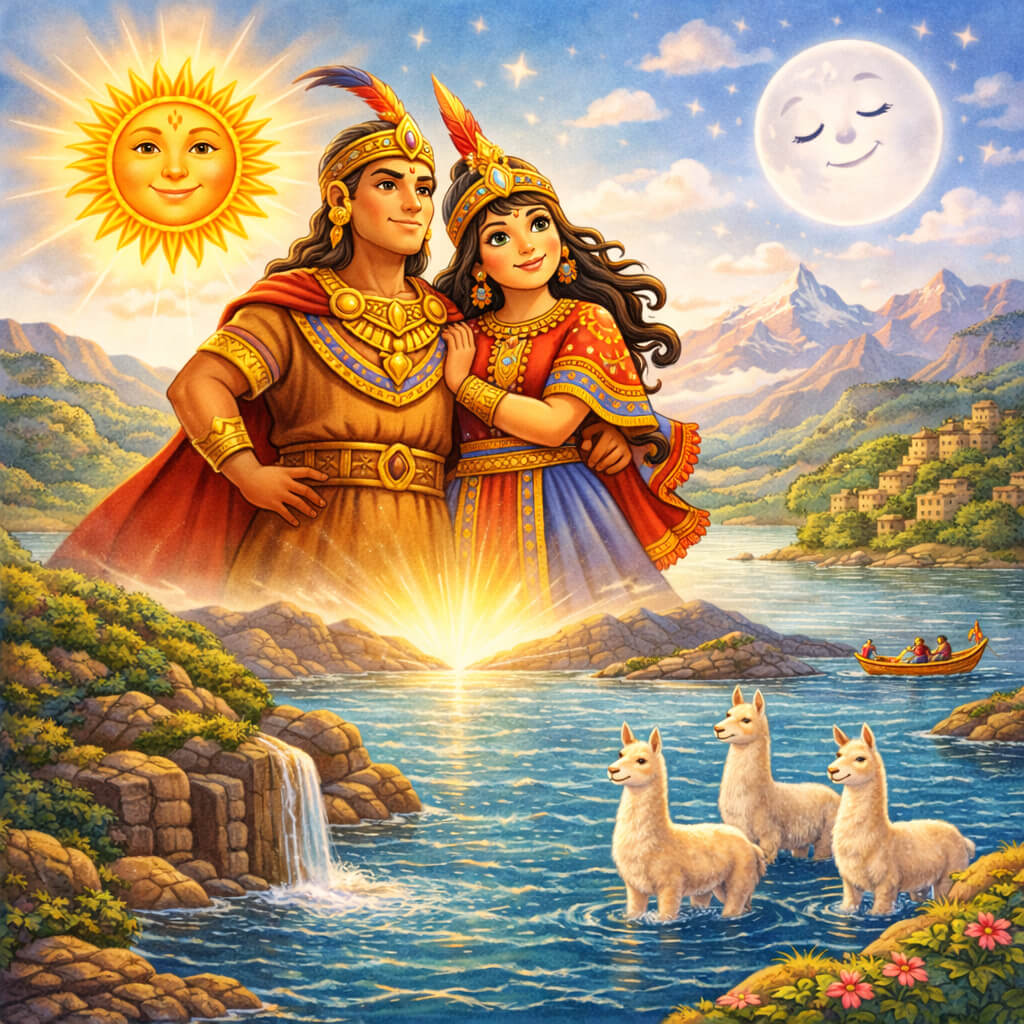
In its place lay a vast and beautiful lake.
The people wept for what had been lost. Yet they also understood that the Apus had shown mercy. The waters had ended the danger and spared those who had turned back with humble hearts.
Amaru stood beside the shore and looked out across the new lake. It was wide and calm, and the mountains were reflected upon its surface like a second world.
An old woman from the village came to stand beside him.
—The valley is gone, she said softly.
—Yes, answered Amaru. —But perhaps it was changed, not taken away.
The old woman looked across the water.
—Then let us remember why, she said.
From that day on, the people treated the place with great respect. They told their children how beautiful the valley had once been, how pride had led many hearts astray, and how the mountains had answered with both justice and mercy.
And so, the old people say, that is how Lake Titicaca came to be: born where a green valley once rested, beneath the watchful eyes of the sacred mountains. Its waters still shine under the sun and moon, and when the wind moves across them, some say it carries the memory of the old warning.
For this reason, the people remembered something very important: curiosity without wisdom may lead to sorrow, but respect can protect what is precious.
The end